A research team at the LKS Faculty of Medicine, the University of Hong Kong (HKUMed), has developed a novel live-attenuated vaccine candidate, cb1, capable of generating broad immunity against a wide range of beta-coronaviruses with a single intranasal dose. The vaccine not only prevents severe disease, but also effectively blocks viral transmission in animal models, offering a promising strategy for pandemic preparedness against future coronavirus threats. The groundbreaking study was published in the journal Proceedings of the National Academy of Sciences (PNAS) [link to the publication].
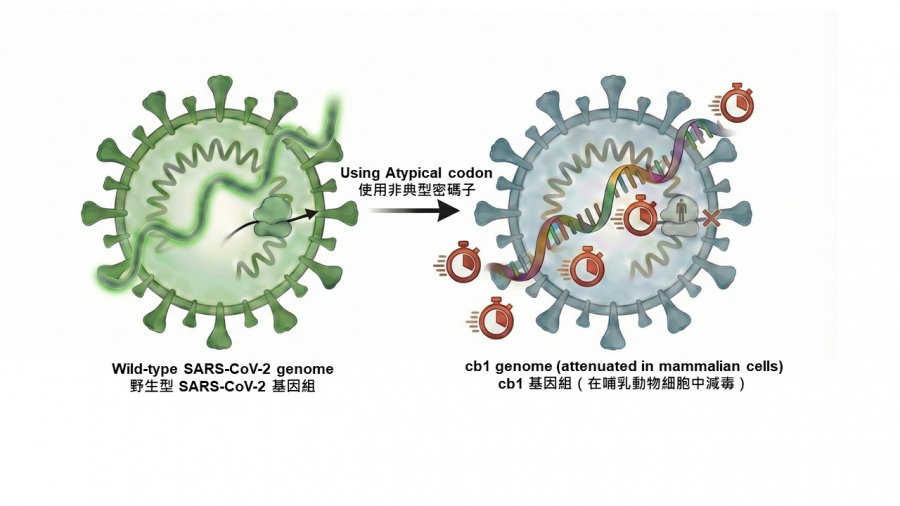
The new vaccine is based on a rational attenuation strategy that alters the codon usage bias of the SARS-CoV-2 genome. This differs from the current COVID-19 vaccines, which target primarily the spike protein and often require frequent updates to keep up with rapidly evolving variants. This approach preserves the complete viral protein sequence while reducing virulence, enabling safe administration while exposing the immune system to a full spectrum of coronavirus antigens.
Four main features offer internal and external protection
- Broad protection: A single dose of cb1 provided complete protection in mice against lethal challenges from ancestral SARS-CoV-2, recent Omicron subvariants (EG.5 and JN.1), SARS-CoV-1, and human beta-coronavirus hCoV-OC43, which causes the common cold.
- Blocking transmission: In hamster models, cb1 vaccination completely prevented the transmission of SARS-CoV-2 to uninfected animals via particles, droplets, exhaled particles in the air (i.e. aerosols) and direct contact. This is a critical feature missing from most current intramuscular vaccines.
- Robust and durable immunity: cb1 vaccination stimulated strong neutralising antibodies and potent T-cell responses in both systemic and mucosal tissues.
- Overcoming immune imprinting: When used as a booster in animals pre-vaccinated with conventional vaccines (inactivated or mRNA), cb1 broadened the antibody response to cover a more diverse range of coronaviruses, suggesting that it can enhance and update existing immunity.
Offering wide-ranging defence against beta-coronaviruses
Professor Leo Poon Lit-man, Daniel C K Yu Professor in Virology, Chair Professor of Public Health Virology, School of Public Health, HKUMed, and Co-Director of The Hong Kong Jockey Club Global Health Institute (HKJCGHI), stated, ‘Our codon-deoptimisation strategy allows us to substantially weaken the virus without changing a single amino acid. The vaccine replicates only to the extent needed to comprehensively train the immune system, while remaining too weak to cause disease. The breadth of protection we have observed spanning multiple species of beta-coronaviruses is exceptionally promising for the development of a universal coronavirus vaccine.’
Professor Malik Peiris, Emeritus Professor and Honorary Clinical Professor from the same School, added, ‘The vaccine’s ability to block transmission is a game-changer. By inducing strong mucosal immunity in the respiratory tract, this vaccine has the potential to both protect individuals and cut chains of transmission in the community, which is crucial for controlling future outbreaks and pandemics.’
A promising tool for future epidemics
The continuous emergence of SARS-CoV-2 variants and the persistent zoonotic threat posed by animal coronaviruses underscore the urgent need for broadly protective vaccines. The cb1 vaccine platform demonstrates that a single, intranasally administered vaccine can confer wide-ranging immunity that may protect against both current and future beta-coronavirus spillovers, potentially eliminating the need for frequent vaccine updates.
About the research team
The research project was led by Professor Leo Poon Lit-man, Daniel C K Yu Professor in Virology, Chair Professor of Public Health Virology, School of Public Health, HKUMed, and Co-Director of The Hong Kong Jockey Club Global Health Institute (HKJCGHI). Major team members from the same School include Dr Nigeer Te, Dr Alex Chin Wing-hong, Dr Gu Haogao and Professor Malik Peiris. The international collaborators are Dr Tan Chee Wah and Professor Wang Linfa, from the National University of Singapore, Professor Zhao Jincun from the Guangzhou Institute of Respiratory Health, Professor Feng Bo from The Chinese University of Hong Kong, and Dr Ahmed Abdul Quadeerl, Professor Matthew McKay and Dr Sophie Valkenburg from the University of Melbourne.
About The Hong Kong Jockey Club Global Health Institute (HKJCGHI)
The Hong Kong Jockey Club Global Health Institute (HKJCGHI) was established on 1 March 2024, with support from The Hong Kong Jockey Club Charities Trust. The Institute aims to enhance global pandemic preparedness through vaccine research, development and implementation. It unites world-leading scientists to foster collaboration and innovation in vaccine research and trains future global health leaders. More information can be found at www.hkjcghi.org.
About the Centre for Immunology & Infection (C2i)
The Centre for Immunology & Infection (C2i) focuses on developing new vaccines and therapeutic strategies to address public health challenges and make Hong Kong a global centre of excellence for precision medicine and innovative interventions targeting emerging infectious diseases. More at www.c2i.hk
Acknowledgements
The research was supported by the Collaborative Research Fund and Theme-Based Research Scheme of the Research Grants Council, the Government of the Hong Kong Special Administrative Region of the People’s Republic of China, The Hong Kong Jockey Club Global Health Institute, InnoHK initiative of the Innovation and Technology Commission of the HKSAR Government, and the Singapore National Medical Research Council.
Media enquiries
Please contact LKS Faculty of Medicine of The University of Hong Kong by email (medmedia@hku.hk).

 Facebook
  HKU IOS App
  HKU Android App
  Social Media and Apps