On March 24, 2026, the University of Hong Kong (HKU) welcomed Mr. Tianwei Yao, Director-General of the Standard and Quota Department of the Ministry of Housing and Urban-Rural Development (MOHURD), for an inspection and guidance visit to the Hong Kong Branch of the National Centre of Technology Innovation for Digital Construction (NCTI-DC). NCTI-DC was established in Wuhan’s Huazhong University of Science and Technology (HUST) for the advancement of digital construction in January 2022 and the Hong Kong Branch was established in October 2024 to leverage on Hong Kong’s unique advantage of “relying on the motherland, connecting the world” that aims to provide a platform for national and international exchanges in the advancement of digital transformation in construction. This visit highlights the importance that the Ministry of Housing and Urban-Rural Development paid in advancing construction technology, overcoming the "bottleneck" problems, and promoting China's construction industry to go global under the "Belt and Road" initiative.
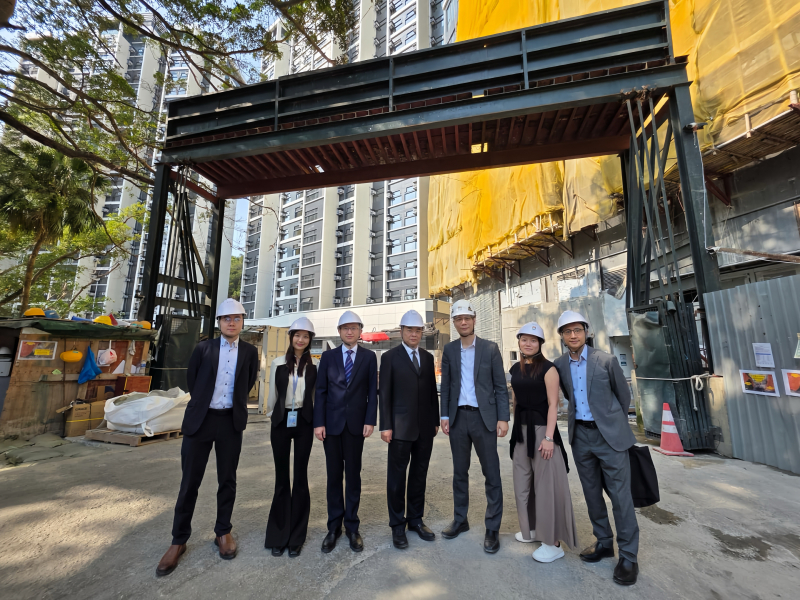
To gain a practical understanding of the local application of Modular Integrated Construction (MiC), Mr. Yao's visit commenced with a tour of HKU's High West Site Development. As a significant pilot project for residential development in Hong Kong, the site utilizes 1,502 Advanced Hybrid MiC modules to efficiently construct expansive student residences and staff quarters.
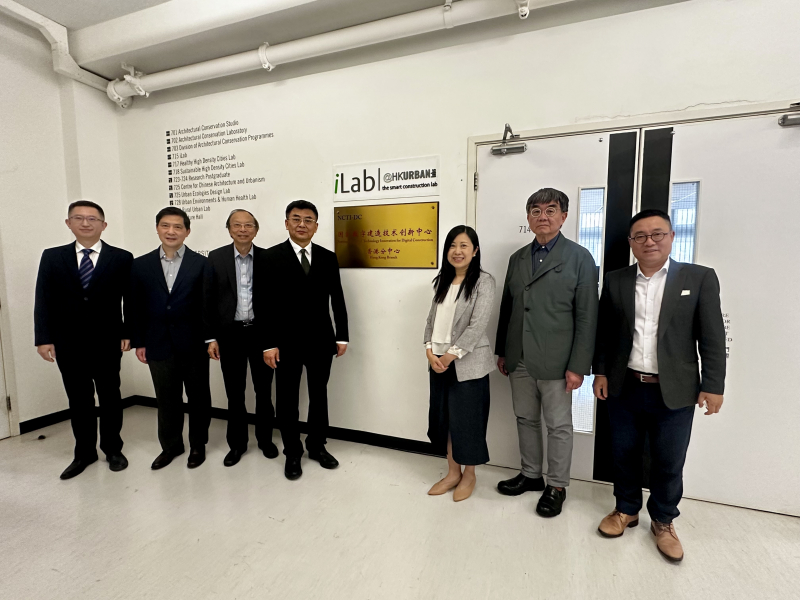
Following the site tour, Mr. Yao proceeded to visit the Hong Kong Branch of the NCTI-DC, located at the iLab in the Knowles Building on the HKU campus.
It began with welcoming addresses from Professor Alice Wong, Associate Vice-President (Research) of HKU, and Professor Yung Ho Chang, Dean and Chair Professor of the Faculty of Architecture. Both emphasized the University’s dedication to advancing research excellence and fostering cross-border architectural and construction innovation that aligns with the nation's strategic development goals.
Professor Wilson Lu, Director of the Hong Kong Branch and Head of the Department of Real Estate and Construction, presented how the Branch worked with the National Centre, specifically targeting "bottleneck" construction technologies to empower the "Going Global" strategy of Chinese construction and the broader Belt and Road Initiative.
During his presentation, Professor Lu outlined two core research initiatives designed to advance digital technology in the construction industry:
- Blockchain-Enabled Modular Construction: Showcasing the innovative "MiC Trio" suite, comprising e-InStar (for off-site quality inspection), e-TranStar (for en-route environmental monitoring), and e-InstalStar (for on-site project management), this initiative assigns a secure, blockchain-backed digital "birth certificate" to prefabricated building modules. Certified by authoritative third parties, this robust system ensures complete quality and logistical traceability, empowering Chinese construction enterprises to confidently expand their operations along the Belt and Road regions. The AiCore, an important component of e-TranStar that uses artificial intelligence for logistic scheduling and transport monitoring system of prefabricated building modules manufactured offsite for just-in-time, orderly, and safe onsite assembly, has won a Gold Medal at the 2026 51st International Exhibition of Inventions Geneva and the Hong Kong ICT Awards 2025: Smart Mobility Best Use of AI Award in 21 November last year.
- Smart City Health Check: Echoing the Central Urban Work Conference's directives on urban renewal and structural safety, this research utilizes drones and Artificial Intelligence to conduct vital "health checks" on city infrastructure. A standout achievement in this area is eCheckGo, a Large Defect Model—driven AI system capable of scalable, ultra-fast building inspections—assessing an entire building in roughly 10 seconds. This groundbreaking system recently won the Gold Medal with Congratulations of the Jury at the 2026 51st International Exhibition of Inventions in Geneva.
A discussion session was subsequently hosted by Prof. Anthony Yeh, Member of the Chinese Academy of Sciences and Chairman of the Expert Advisory Committee of the Hong Kong Branch. Professor Hanbin Luo, Director of the NCTI-DC, who flew from Wuhan especially for this meeting, highlighted the critical synergy between the National Lab in mainland and the Hong Kong Branch in driving industry-wide digital transformation.
The visit concluded with a comprehensive summary delivered by Mr. Yao, followed by a guided tour of the Branch's award-winning research and development projects. Mr. Yao acknowledged the Hong Kong Branch's pivotal role in pioneering smart construction technologies and recognized HKU's proactive integration into the nation's broader technological and urban development blueprints.
Moving forward, HKU and the NCTI-DC will continue to deepen their collaboration with MOHURD. By fostering high-level research and nurturing top-tier talent, HKU remains committed to conducting world-class, innovative construction research, contributing to the sustainable, safe, and intelligent urbanization of cities both in Hong Kong and the Mainland and along the Belt and Road regions.
Related Links:
National Centre of Technology Innovation for Digital Construction (NCTI-DC)
https://ndc.hust.edu.cn/index.htm
Hong Kong Branch of the National Centre of Technology Innovation for Digital Construction (NCTI-DC)
https://dchk.hku.hk/en

 Facebook
  HKU IOS App
  HKU Android App
  Social Media and Apps